
On this page
- How anodized aluminium asset tags are made
- What we can print on your tags
- Tag options
- Where aluminium asset tags work best
- Aluminium thickness and sizes
- Adhesive choices for aluminium tags
- Aluminium asset tags vs stickers
- Industries that use our aluminium asset tags
- Why buy from a Nairobi manufacturer
- How to apply aluminium asset tags correctly
- Writing a specification for aluminium asset tags
- Why asset tags fail, and how to avoid it
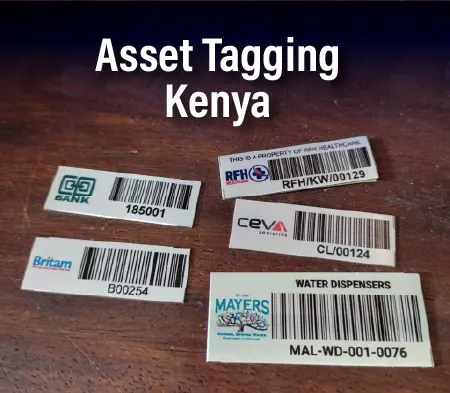
Aluminium asset tags (also called aluminum asset tags or metal asset tags) are the most durable way to label equipment, furniture and vehicles. We print anodized aluminium asset tags in our Nairobi workshop with your logo, a unique asset number and a barcode or QR code, then supply them ready to apply or fix them on site for you.
Because the print is sealed inside the aluminium rather than sitting on top of it, the tags resist scratches, cleaning chemicals, heat and sunlight, so the number your auditor scans in five years is the same one you printed today.
How anodized aluminium asset tags are made
Anodizing grows a hard, porous oxide layer on the surface of the aluminium. The image, your logo, text, numbers and barcode, is printed into that layer and the pores are then sealed. The result is a tag where the graphics are part of the metal. It is the same reason anodized aluminium is used for nameplates on industrial machinery.
Read more in the components of an aluminium asset tag and why aluminium tags last longer.
What we can print on your tags
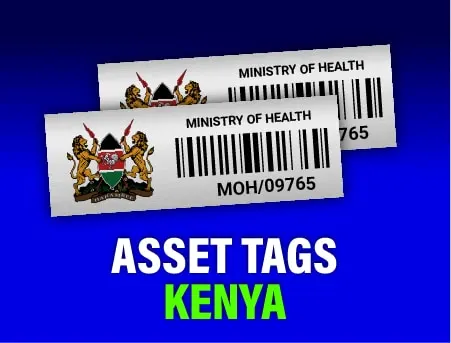
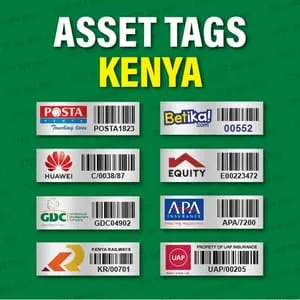
- Logo and company name in one or more colours.
- Sequential asset numbers in any format, e.g. ABC/ICT/000123, matched to your register.
- Barcodes (commonly Code 128 or Code 39) or QR codes that link to an asset record.
- Short messages such as "Property of…", "Do not remove" or a phone number for returns.
- Colour coding by department, site or asset class.

Tag options
| Option | Choices | Notes |
|---|---|---|
| Finish | Matte silver, gloss, gold or coloured anodizing | Matte silver is the most readable for scanners |
| Shape | Rectangle, rounded corners, custom shapes | Rounded corners resist peeling at the edges |
| Size | 39 x 13 mm (standard) up to 100 x 50 mm | 39 x 13 mm suits most assets; see the size table below |
| Code | Barcode, QR code, or number only | See barcode and QR tags |
| Fixing | Acetone-activated adhesive, self-adhesive, rivet or screw holes | See acetone-activated tags |

Where aluminium asset tags work best
Use aluminium wherever a paper or plastic label would fade, peel or be scratched off: office furniture, workshop equipment, generators, vehicles, medical devices, lab equipment, school property and anything kept outdoors or cleaned often. For lower-risk indoor IT equipment on a tight budget, polyester labels can be a good complement.
Compare materials in our aluminium vs other materials guide.

Aluminium thickness and sizes
Most asset tags are made from thin, flexible aluminium that follows slightly curved surfaces while staying rigid enough to resist bending. Thicker aluminium is used for plates that are riveted or screwed onto machinery. We print every tag type in eight standard sizes. 39 x 13 mm is our standard and recommended size: it fits laptops and most equipment while leaving room for a readable number and a clear barcode. Larger sizes suit furniture, machinery and assets scanned from a distance.
| Tag size | Typical use |
|---|---|
| 39 x 13 mm | Standard and recommended size. Laptops, monitors, phones, printers and most office equipment |
| 45 x 15 mm | Small equipment where a slightly larger number helps |
| 50 x 20 mm | IT equipment and small furniture |
| 50 x 30 mm | Furniture and equipment with a logo and barcode |
| 60 x 30 mm | Furniture, cabinets and larger equipment |
| 75 x 40 mm | Machinery and equipment scanned from further away |
| 80 x 50 mm | Machinery, generators and vehicles |
| 100 x 50 mm | Large plant, heavy equipment and outdoor assets |

Adhesive choices for aluminium tags
- Acetone-activated adhesive, permanent bond on furniture, painted metal and textured surfaces.
- Self-adhesive (peel and stick), fast application on smooth items like laptops and monitors.
- Rivet or screw holes, mechanical fixing for vehicles, generators and outdoor equipment.

Aluminium asset tags vs stickers
| Anodized aluminium tag | Paper or vinyl sticker | |
|---|---|---|
| Print durability | Sealed into the metal | Ink on the surface, wears with cleaning |
| Heat and sunlight | Resistant | Fades and curls |
| Chemicals and solvents | Resistant | Smudges or dissolves |
| Look | Professional metal finish | Temporary |
| Cost over asset life | One tag for the life of the asset | Often replaced at every audit |
Industries that use our aluminium asset tags
Government ministries and county governments, universities, schools and colleges, hospitals and laboratories, banks and insurance companies, NGOs and donor-funded projects, hotels, manufacturers, construction and logistics firms. The same tag design can be used across every branch, so assets moved between sites remain identifiable.
Why buy from a Nairobi manufacturer
Because we print locally, you get shorter lead times than importing, free design proofs, quick reprints of damaged or missing numbers, and support from the team that made the tags. We deliver across Kenya, Nairobi, Mombasa, Kisumu, Nakuru, Eldoret and every county, and ship to clients across Africa. See our samples or learn about types of aluminium asset tags.
How to apply aluminium asset tags correctly
- Choose a flat, visible spot in the same position on similar items.
- Clean off dust, grease and old labels, then let the surface dry.
- For acetone-activated tags, activate the adhesive; for self-adhesive tags, peel the liner.
- Press firmly across the whole tag for several seconds.
- Scan the tag and record it against the asset in your register.
Prefer not to do it yourself? Our team can verify and tag everything through our fixed asset tagging service.
Writing a specification for aluminium asset tags
Public bodies, donors and auditors often ask for tags to a stated specification. A clear one also makes quotes easy to compare. Set out:
- the material and finish (anodized aluminium, matt silver is the easiest to scan);
- the size, from our eight standard sizes, or a custom size;
- the code: barcode format, QR code or number only, and the number range;
- the fixing method: acetone-activated adhesive, self-adhesive, or rivet or screw holes;
- the logo and wording, and the artwork format you will send;
- where the tags will be used: indoors, outdoors, near heat, chemicals or frequent cleaning.
Send that list and we can quote against it. If you only have part of it, we will ask the rest and recommend a tag.
Why asset tags fail, and how to avoid it
Aluminium itself rarely fails. Most problems come from the way a tag is chosen or applied.
- Dirty or oily surface. The tag lifts at the edges. Clean and dry the surface first, and press the whole tag down.
- Wrong adhesive for the surface. Smooth plastic suits self-adhesive tags; painted metal, textured plastic and furniture suit acetone-activated tags; vehicles and outdoor plant suit rivets or screws.
- A number that is too small to scan. If staff scan from a distance, choose a larger size so the code stays readable.
- Reused or duplicated numbers. Two assets with one number makes the register unreliable. Retire a number when the asset is disposed of.
- No register behind the tag. A tag only helps if its number leads to a record. See the asset tagging process.
Anodizing also protects the metal. Aluminium does not rust the way steel does, and the sealed anodic layer resists scratches and cleaning. See how long aluminium asset tags last.
Ordering aluminium asset tags
- Send your logo, the number of tags and the number format you want.
- We recommend size, finish and adhesive for your assets.
- You approve a free digital proof.
- We produce and check the tags in sequence.
- We deliver across Kenya or ship to your country, or tag the assets for you through our fixed asset tagging service.
For guidance on cost, see asset tags price in Kenya. For design ideas, read how to design custom aluminium asset tags.
Not sure which tag you need? Start with asset tags in Kenya: types, sizes and how to choose.
Aluminium asset tag prices
Aluminium asset tags in Kenya start from KSh 60 per tag, with bulk discounts for larger quantities. The standard 39 x 13 mm tag is the most economical size. Polyester labels start from KSh 35 per tag. See what affects asset tag prices, or request a quote by WhatsApp or email for the exact cost of your order.
Frequently asked questions
How long do aluminium asset tags last?
Anodized aluminium asset tags are designed to last for the working life of the asset in normal indoor conditions and for many years outdoors, because the print is sealed inside the aluminium's oxide layer rather than printed on the surface.
Can aluminium asset tags be scanned?
Yes. We print barcodes or QR codes with high contrast and check scan quality before delivery, so they work with standard barcode scanners and smartphone apps.
What is the difference between anodized and printed aluminium tags?
On an anodized tag the image is sealed into the metal, so it resists scratches, chemicals and UV. A surface-printed tag has ink on top of the metal, which can wear off with cleaning and handling.
Can you include our logo and existing asset numbers?
Yes. Every tag can carry your logo, company name and numbers in your existing format, printed in sequence to match your register.
Do you deliver outside Nairobi?
Yes. We deliver across Kenya and ship aluminium asset tags to organisations in East Africa and other African countries.
Do aluminium asset tags rust?
No. Aluminium does not rust like steel, and the anodized layer adds a hard, sealed surface that resists scratches and cleaning.
Can an aluminium asset tag be removed?
Acetone-activated tags bond permanently, so removing one normally damages it. For extra security choose a tamper-evident tag or rivet the plate on.
What should I include when asking for a quote?
Quantity, number range, size, code type, fixing method, logo and wording, and where the tags will be used. If you are missing some of these, we will ask and recommend.
Can you match tags to a tender specification?
Yes. Send the specification and we will quote against it, including logo, numbering, barcode and tag size.
Order online

Helpful guides
Guide, 9 min read
Types of Aluminium Asset Tags in Kenya
Types of aluminium asset tags made in Kenya: barcode, QR, anodized, embossed and tamper-evident labels, with the adhesiv…
Guide, 2 min read
Aluminium Asset Tags: Uses and Specifications
Learn where aluminium asset tags work well and what to specify for size, numbering, barcode, finish and attachment in Ke…
Guide, 13 min read
Acetone-Activated vs Riveted Aluminium Asset Tags: Which Installation Method Is Best?
Acetone-activated adhesive or rivets? Compare bond strength, surfaces, cost and removal risk to pick the right installat…