
On this page
- What our fixed asset tagging service includes
- How a tagging project runs
- Choosing the right tag for each asset
- Why organisations tag their fixed assets
- Who we work with
- Tags only, or the full service
- What information we capture for each asset
- Common problems we fix
- Fixed asset tagging for different sectors
- Keeping the register current after tagging
- Asset tagging service prices
Our fixed asset tagging services in Kenya take you from an incomplete asset list to a verified, tagged and searchable asset register. We supply the aluminium asset tags, send a team to fix them on every item, capture each asset's details and hand over a clean digital register that your finance team and auditors can rely on.
Whether you run a head office in Nairobi, branches across counties, a school, a hospital or a donor-funded project, the process is the same: count what you own, give every item a permanent identity, and keep the record up to date.
What our fixed asset tagging service includes
- Planning and asset classes. We agree numbering formats, asset categories, locations and departments with your finance or admin team before a single tag is printed.
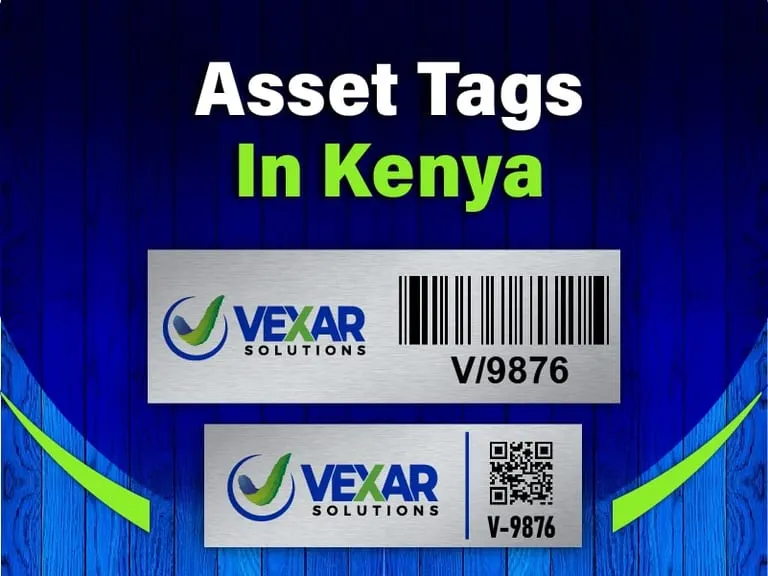
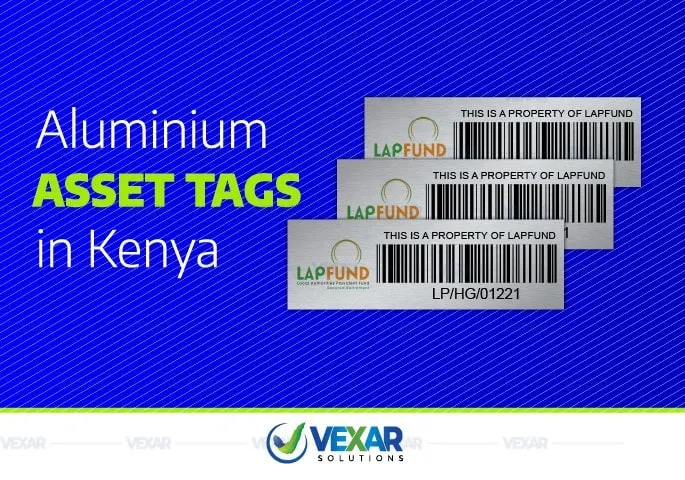
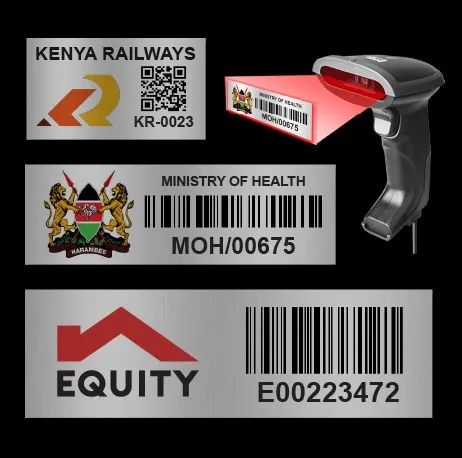
- Tag design and production. Anodized aluminium tags with your logo, a unique number and a barcode or QR code, produced in sequence in our Nairobi workshop.
- Physical verification. Our team walks every room, store and site, checks each item against your existing register and records anything missing, surplus or unrecorded.
- On-site tagging. Tags are fixed with acetone-activated adhesive, rivets or screws depending on the surface, so they stay put.
- Data capture. For every asset we record the tag number, description, serial number, location, custodian and condition, with photos where needed.
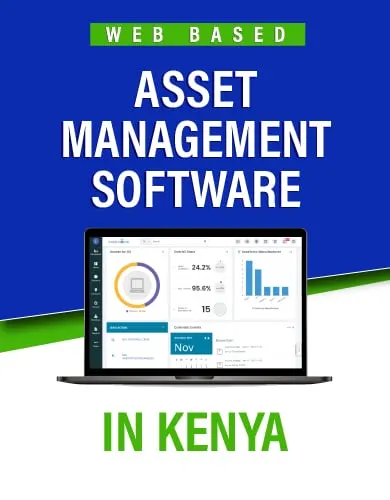
- Digital asset register. A clean, reconciled register delivered in Excel or loaded into our asset management software.
- Scanners and training. Barcode or QR scanners and a short training session so your staff can run future audits themselves.
How a tagging project runs
- Site survey and quote. Tell us roughly how many assets you have and where. We confirm scope, timeline and the tag types each asset class needs.
- Design approval. You receive a free proof showing logo, number format and barcode. Nothing is printed until you approve it.
- Production. Tags are printed in the exact number range agreed and checked for scan quality before they leave the workshop.
- Verification and tagging. Our team works room by room, tagging and capturing data without disrupting your operations.
- Reconciliation. We compare what we found with your books and flag differences: missing items, untagged items and duplicates.
- Handover. You receive the final register, an exceptions report and spare tags for new purchases.

Choosing the right tag for each asset
Not every asset needs the same tag. Mixing tag types by asset class keeps the project durable and cost-effective.
| Asset class | Recommended tag | Fixing |
|---|---|---|
| Laptops, desktops, printers | Aluminium barcode or polyester label | Self-adhesive |
| Office furniture | Anodized aluminium barcode tag | Acetone-activated adhesive |
| Vehicles, generators, machinery | Metallic barcode tag | Rivets or acetone-activated adhesive |
| High-theft or portable items | Tamper-proof tag | Destructible adhesive |
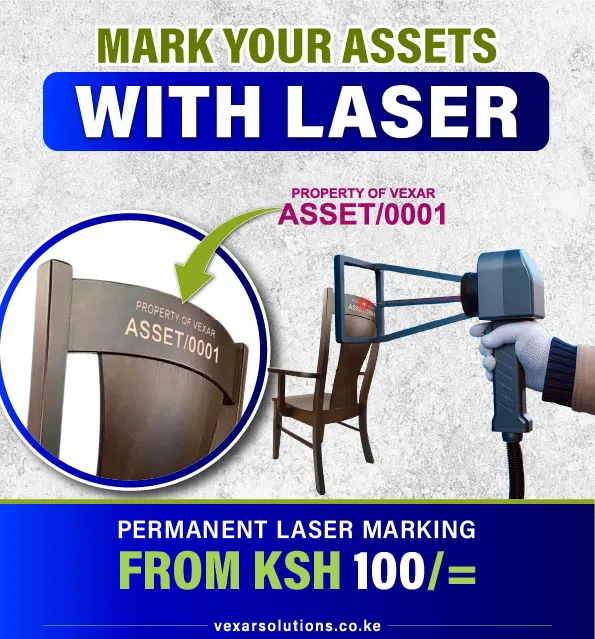
| Tools and metal parts | Laser marking | Engraved directly |
| Assets checked by phone | QR code tag | Adhesive or rivets |

Why organisations tag their fixed assets
Audits. External auditors test the fixed asset register against physical items. A tagged asset can be found and confirmed in seconds; an untagged one becomes a query.
Tax records. Capital allowances claimed with KRA should match real, identifiable assets. Read how wear-and-tear allowances relate to physical tagging.
Public sector reporting. Entities moving to IPSAS accrual accounting must verify and value every asset. Our guide on fixing ghost assets explains the steps.
Loss prevention. Visible, permanent ownership marks discourage theft and make recovered items easy to identify.
Better decisions. Knowing the age, location and condition of assets tells you what to repair, replace or dispose of, and what to insure.

Who we work with
County governments and state agencies, universities and schools, hospitals and clinics, banks and SACCOs, NGOs and donor projects, manufacturers, logistics companies and construction firms. We carry out projects in Nairobi and across Kenya, including Mombasa, Kisumu, Nakuru, Eldoret and Thika, and supply tags to clients in East Africa and the rest of the continent.

Tags only, or the full service
If your team prefers to do the tagging, we can supply printed tags alone, numbered to match your register, with application instructions. For large or multi-site organisations, the full service is usually faster and produces a cleaner register. See what affects the cost of asset tags, then contact us with your asset count for a quote.
What information we capture for each asset
A tag number on its own is not an asset register. During tagging we capture the details your finance team, auditors and managers actually use:
| Field | Why it matters |
|---|---|
| Tag number and barcode/QR | The unique link between the physical item and its record |
| Description, make and model | Identifies the item without needing to see it |
| Manufacturer serial number | Supports warranty claims, insurance and theft reports |
| Asset class and category | Drives depreciation rates and reporting |
| Location: site, building, floor, room | Lets anyone find the asset during an audit |
| Department and custodian | Shows who is responsible for the item |
| Condition | Informs repair, replacement and disposal decisions |
| Photo (optional) | Speeds up identification and dispute resolution |
| Purchase date and cost (from your records) | Needed for valuation and capital allowances |
Common problems we fix
- Registers that don't match reality: items on the books that can't be found, and items in the office that were never recorded.
- Faded or peeling labels: paper stickers from earlier exercises that can no longer be read.
- Duplicate numbers: the same number used twice after several tagging rounds.
- Assets moved without records: equipment transferred between offices or staff with no trail.
- No owner: nobody responsible for an item, so nobody notices when it goes missing.
Our verification report lists each of these so you can resolve them with your auditors before year-end.
Fixed asset tagging for different sectors
County governments and state corporations use tagging to build registers for IPSAS reporting and to answer audit queries on missing or unvalued assets. Schools and universities tag ICT labs, science equipment, furniture and hostels. Hospitals tag medical devices and link each one to maintenance records. NGOs and donor projects tag assets bought with grant funds, often with the donor's name on the tag, and track them across field offices. Companies tag laptops issued to staff, office furniture and branch equipment, and use the register for insurance and tax.
Keeping the register current after tagging
Tagging is the start. To keep the register accurate, tag new purchases before they are issued, record every transfer and disposal, and run a scan-based verification at least once a year. Our asset management software makes this routine, and we supply spare tags in the same number series so new assets fit straight in. For a step-by-step approach, read our fixed asset verification guide.
If you only need the tags, see asset tags in Kenya for types, sizes and fixing methods.
Asset tagging service prices
On-site asset tagging in Kenya costs from KSh 50 to KSh 250 per asset. The rate depends on the quantity and, mostly, on the details captured for each asset during tag installation (for example location, custodian, serial number and photos). Tags themselves start from KSh 60 each. See the asset tags price guide and asset tags in Kenya.
Frequently asked questions
What is fixed asset tagging?
Fixed asset tagging is labelling every physical asset an organisation owns with a durable tag carrying a unique number, usually as a barcode or QR code, and recording it in an asset register. It lets you prove what you own, where it is and who is responsible for it.
How long does an asset tagging project take?
It depends on the number of assets and sites. Tag production normally follows design approval, and on-site tagging is planned room by room so work continues without disrupting your staff. We give you a timeline with the quote.
Can you tag assets outside Nairobi?
Yes. We carry out tagging projects across Kenya and supply printed tags to organisations in East Africa and other African countries.
Do we have to buy software?
No. We can hand over the register as an Excel file. If you want scanning, check-in and check-out, depreciation and reports, our asset management software is available as an option.
Can you match our existing asset numbers?
Yes. We print tags in the exact number range or format your finance team already uses, so the new tags match your current register.
Which adhesive do you use?
For most furniture and equipment we use acetone-activated adhesive, which bonds permanently. For laptops and smooth surfaces we use self-adhesive tags, and for vehicles or outdoor machinery we can rivet or screw tags in place.
Order online

Helpful guides
Guide, 2 min read
Fixed Asset Tagging Checklist
Use this fixed asset tagging checklist to prepare staff, asset data, tag specifications, site access, verification and p…
Guide, 12 min read
The Ultimate Guide to Fixed Asset Verification and Tagging for Kenyan SMEs
A practical fixed asset verification and tagging guide for SMEs: counting, tagging, building the register and keeping it…

Guide, 13 min read
How KRA Wear & Tear Allowances Require Physical Fixed Asset Tagging
How KRA wear-and-tear allowances depend on a verifiable asset register, and how physical asset tags support capital allo…