
On this page
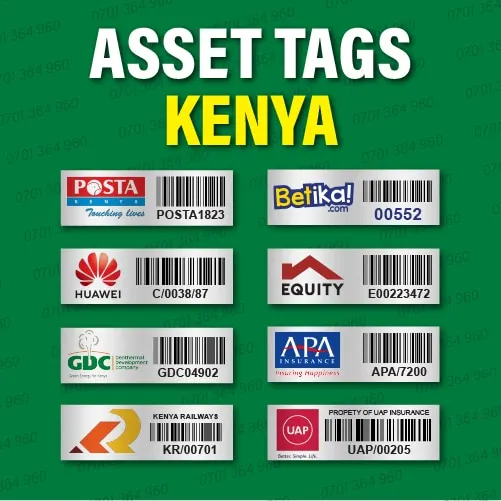
Asset tags in Kenya are the numbered labels and plates that identify the things an organisation owns: laptops, furniture, machines, vehicles, medical equipment and school property. Each tag carries a unique number, often with a barcode or QR code, so a person with a scanner or a phone can match the item in front of them to a line in the asset register.
Vexar Solutions makes asset tags in its Nairobi workshop and has done since 2016. We print anodized aluminium tags, polyester labels and laser-marked metal tags with your logo and your numbering, and we can fix them on your assets and build the register for you. This page is the starting point: it explains the tag types, how to choose between them, and how an order works. Every tag type has its own page with the detail.
The asset tag types we make
Most organisations use one main tag and one or two specialist tags. Pick by where the asset lives and how long the tag must last.
| Tag type | Material and fixing | Suits | Read more |
|---|---|---|---|
| Anodized aluminium tags | Print sealed into the metal; acetone-activated adhesive, self-adhesive or riveted | Furniture, equipment, vehicles, anything cleaned or kept outdoors | Aluminium asset tags printing |
| Acetone-activated tags | Aluminium with an adhesive that bonds permanently once activated | Painted metal, textured plastic, office furniture | Acetone-activated asset tags |
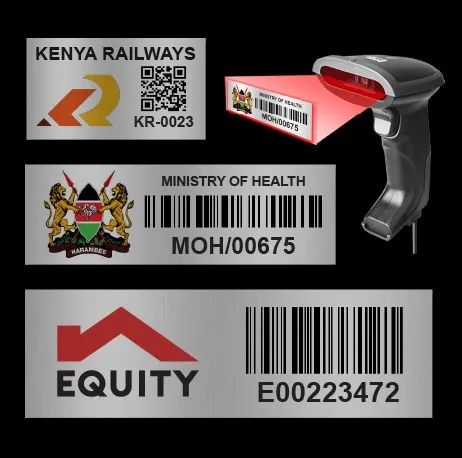
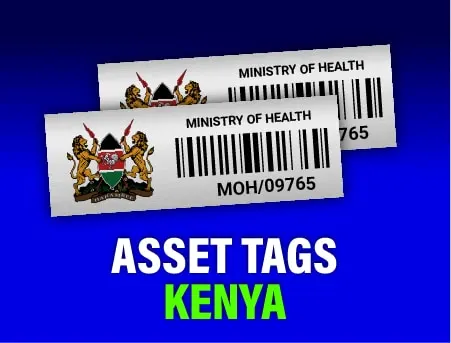
| Barcode tags | Aluminium or polyester with a printed linear barcode | Any asset scanned with a handheld scanner | Barcode asset tags |
| QR code tags | Aluminium or polyester with a QR code | Assets scanned with a phone, or tags that link to a record | QR code asset tags |
| Polyester labels | Printed polyester with self-adhesive backing | Indoor IT equipment and short-life assets | Polyester asset tag labels |
| Self-adhesive tags | Peel and stick on smooth surfaces | Laptops, monitors and phones, where speed matters | Self-adhesive asset tags |
| Tamper-evident tags | Tags that tear or show a mark when removed | Portable, high-theft or donor-funded items | Tamper-proof asset tags |
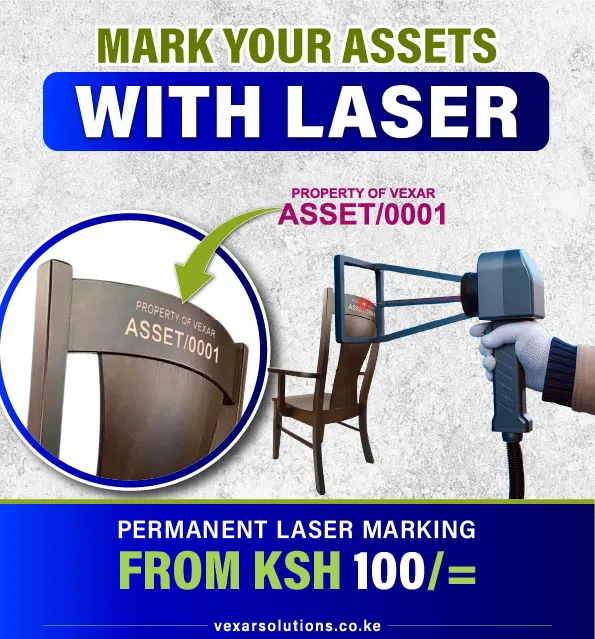
| Laser-marked tags | Number engraved directly into metal | Tools and metal parts, where a tag could be removed | Laser asset tagging |
How to choose the right asset tag
Three questions settle most choices.
- Where does the asset live? Indoors in an office, a tag only has to survive handling and cleaning. In a workshop, a school yard, a hospital ward or on a vehicle it also meets heat, sun, dust and chemicals. Harsher places call for anodized aluminium.
- How long must the tag last? A laptop that will be replaced in three years does not need the same tag as a generator that will stay for fifteen. Match the tag to the working life of the asset, not to the cheapest option.
- How will it be scanned? A warehouse team with handheld scanners reads barcodes quickly. Field staff with phones can read QR codes without extra equipment. If you have not decided, a tag can carry both.
The asset tags buyer's guide goes through these choices in more detail, and aluminium compared with other materials shows the trade-offs side by side.
Asset tag sizes
We make every tag type in eight sizes. 39 x 13 mm is the standard and recommended size: it fits laptops and most office equipment and still leaves room for a readable number and a code.
| Size | Typical use |
|---|---|
| 39 x 13 mm | Standard size: laptops, monitors, printers and most equipment |
| 45 x 15 mm | Small equipment that needs a slightly larger number |
| 50 x 20 mm | IT equipment and small furniture |
| 50 x 30 mm | Furniture and equipment with a logo and barcode |
| 60 x 30 mm | Cabinets, furniture and larger equipment |
| 75 x 40 mm | Machinery scanned from further away |
| 80 x 50 mm | Machinery, generators and vehicles |
| 100 x 50 mm | Large plant, heavy equipment and outdoor assets |
What goes on an asset tag
- A unique asset number in your own format, printed in sequence to match your register. See how to set up a numbering system.
- A barcode or QR code that carries the same number, so scanning never depends on someone typing it correctly.
- Your logo and organisation name, so ownership is clear at a glance.
- A short message such as "Property of" or a phone number for returns, if you want one.
Keep the number short, avoid characters that look alike, and never reuse a number once an asset has been disposed of. A barcode should carry the identifier only; the register holds everything else and can be updated without re-tagging.
How tags are fixed to assets
- Acetone-activated adhesive gives a permanent bond on painted metal, textured surfaces and furniture. See the application guide.
- Self-adhesive backing is quick on smooth items such as laptops, monitors and phones.
- Rivets or screws hold plates on vehicles, generators and outdoor equipment where adhesive alone would not be enough. The acetone-activated and riveted comparison helps you pick.
Surface preparation matters as much as the adhesive: clean, dry and free of grease. Tags applied to dirty or oily surfaces lift, whichever tag you chose.
Tags only, or a full asset tagging project
Some organisations order tags and apply them themselves. Others ask us to do the whole job: count the assets, fix the tags, record each one and hand over a clean register. Both work. If your team will tag in-house, use the fixed asset tagging checklist and the asset tagging process guide. If you want us on site, see our fixed asset tagging services in Kenya.
The register behind the tags can live in Excel or in software. Our own system, VexCloud AMS (Asset Management System), generates numbered barcode and QR tags, runs physical verification and keeps the register. You do not have to use it: we supply tags to organisations that keep their registers elsewhere.
Who we supply
We make asset tags for county governments and state agencies, NGOs and donor-funded projects, banks and SACCOs, schools and universities, hospitals and manufacturers. Public bodies and funders often set tag requirements in a tender: a logo, a unique number, a barcode and a stated tag size. Our tags are made to that kind of specification. The guide for schools, hospitals and NGOs and the one on fleet and heavy equipment cover typical needs in those sectors.
What to put in an asset tag specification
Whether you are writing a tender or just a purchase request, a complete specification avoids quotes that cannot be compared.
- Quantity and number range.
- Material and finish (for example anodized aluminium, matt silver).
- Size, and shape if it is not a plain rectangle.
- Code type: barcode format, QR code, or number only.
- Fixing method: adhesive type, rivet holes or screw holes.
- Logo and wording, with the artwork format you will supply.
- Environment: indoor, outdoor, exposure to heat, chemicals or cleaning.
- Delivery location and whether on-site tagging is included.
How an order works
- Send the details. Quantity, size, tag type, numbering and logo, through WhatsApp, email or the quote form.
- Approve the proof. We prepare a free proof of the artwork and numbering for you to check.
- Production. Tags are printed in our Nairobi workshop in your number sequence, and scan quality is checked before delivery.
- Delivery or tagging. We deliver across Kenya and ship to East Africa and other African countries, or send a team to fix the tags on site.
Prices depend on material, size, quantity and finish, so we quote each job. See what affects the price of asset tags, then request a quote. We usually reply within the hour during working hours, Monday to Saturday, 8am to 6pm.
More on asset tags in Kenya
Frequently asked questions
What are asset tags?
Asset tags are labels or plates with a unique number, often with a barcode or QR code, fixed to an asset so it can be identified and matched to a record in the asset register.
Which asset tag lasts longest?
Anodized aluminium tags last longest because the print is sealed into the metal. Polyester labels suit indoor equipment with a shorter working life.
What size asset tag should I order?
39 x 13 mm is our standard and recommended size for laptops and most equipment. Larger sizes up to 100 x 50 mm suit machinery, vehicles and outdoor assets.
Can asset tags carry our logo and existing numbers?
Yes. Every tag can carry your logo, organisation name and numbers in your own format, printed in sequence to match your register.
Should I choose barcodes or QR codes?
Barcodes suit handheld scanners and fast bulk counts. QR codes can be read with a phone camera. A tag can carry both if you are unsure.
Do you fix the tags on our assets?
Yes. We can supply tags for your team to apply, or send a team to count, tag and record your assets on site.
Do you deliver outside Nairobi?
Yes. We deliver across Kenya and ship asset tags to East Africa and other African countries.
How do I get a price?
Prices depend on material, size, quantity and finish. Send the details through WhatsApp, email or the quote form and we reply with a quote, usually within the hour during working hours.
Order online

Helpful guides
Guide, 4 min read
How to Choose the Right Aluminium Asset Tags: Material, Adhesive and Finish
How to choose aluminium asset tags: thickness, finish, adhesive or rivets, size and barcode type, matched to each asset …

Guide, 5 min read
5 Types of Fixed Asset Tags for Efficient Asset Tagging
The 5 fixed asset tag types most used in Kenya, compared: aluminium, barcode, QR, polyester and tamper-proof, with the a…
Guide, 9 min read
Types of Aluminium Asset Tags in Kenya
Types of aluminium asset tags made in Kenya: barcode, QR, anodized, embossed and tamper-evident labels, with the adhesiv…