Guide, 2 min read
The Asset Tagging Process: A Step-by-Step Guide
Plan an asset tagging project from scope and data cleanup through numbering, label application, reconciliation and regis…
 View Samples
 Asset tagging for fleets and heavy equipment: tags that survive UV, dust, vibration and washing on trucks, machinery and containers in Kenya.




Fleet vehicles, earthmovers, trailers and shipping containers operate in some of the toughest environments in Kenya. From heavy dust along the Northern Corridor to prolonged UV exposure at construction sites, ordinary sticker labels can fade, peel, crack or become unreadable long before the asset reaches the end of its working life.
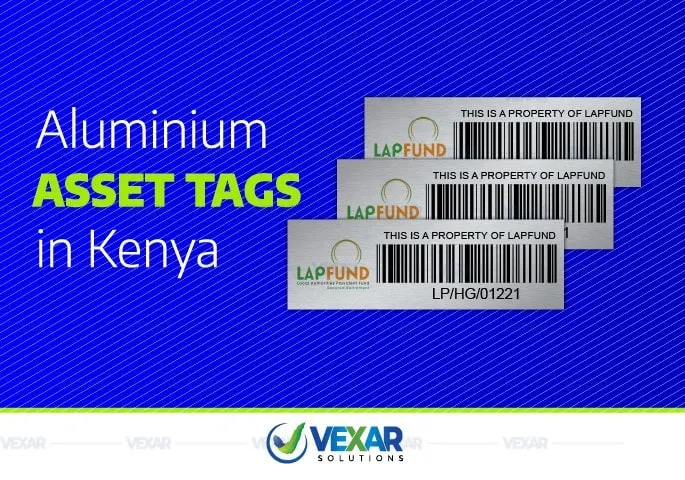
For logistics and construction companies, aluminium asset tags businesses use provide a more durable way to identify high-value equipment. Anodized aluminium with permanent laser marking can maintain asset numbers, barcodes and QR codes through demanding outdoor conditions, repeated washdowns, vibration and physical handling.
For fleet managers, plant engineers and construction supervisors, the objective is simple: keep every asset identifiable, trackable and connected to the company’s fixed asset register.
A logistics or construction company may have hundreds or thousands of assets distributed across Nairobi, Mombasa, regional depots, construction sites and transport routes.
These can include:
If an identification label fails, the business can lose an important link between the physical asset and its digital or accounting record.
This can affect:
A durable asset tag is therefore more than a label.
It is part of the company’s asset-control system.
A fleet vehicle operating between Nairobi and Mombasa can encounter significantly different conditions during its working life.
A construction machine may spend months at an exposed site where dust, rain, mud and direct sunlight are unavoidable.
A container can experience repeated loading, unloading, stacking and transport.
These environments create several threats to conventional labels.
Continuous sunlight can cause some plastic and printed labels to fade, crack or deteriorate.
Dust can accumulate on equipment and contribute to surface abrasion during cleaning and handling.
Construction and agricultural equipment can be repeatedly exposed to water, mud and wet conditions.
Machinery can encounter diesel, oils, lubricants, hydraulic fluids, cleaning agents and other industrial substances.
Fleet and construction equipment may be subjected to aggressive cleaning and washdowns.
Heavy machinery experiences continuous mechanical vibration and occasional impacts that can damage poorly selected labels.
These factors make material selection critical.
Anodized aluminium is particularly useful for outdoor and industrial asset identification because the anodizing process creates a durable oxide layer on the aluminium surface.
This provides a suitable base for permanent identification methods such as laser marking.
The result can be a tag that maintains its identification through prolonged outdoor exposure.
Compared with basic paper or vinyl stickers, aluminium can provide greater resistance to:
However, the exact performance depends on the aluminium specification, anodizing process, marking technology, adhesive and installation method.
A quality tag is therefore a complete system rather than simply a piece of metal.
Laser marking is particularly valuable where long-term readability matters.
Instead of relying on ordinary surface printing that can wear away, laser marking interacts with the anodized aluminium surface to create a permanent visual identification.
This can include:
For heavy equipment, the barcode or QR code should be tested for readability before large-scale deployment.
A barcode that looks good when new but becomes difficult to scan after years of outdoor exposure provides limited operational value.
Not every asset needs aluminium.
For office equipment operating indoors, vinyl or synthetic labels can be a practical and economical option.
For heavy equipment, the environment changes the calculation.
| Feature | Anodized Aluminium | Vinyl Sticker | Paper Label |
|---|---|---|---|
| Outdoor durability | High | Medium to low | Low |
| UV resistance | High | Varies | Low |
| Scratch resistance | High | Medium | Low |
| Washdown resistance | High when properly specified | Varies | Low |
| Chemical resistance | High depending on specification | Varies | Low |
| Heavy machinery | Excellent | Limited | Poor |
| Fleet vehicles | Excellent | Moderate | Poor |
| Indoor office equipment | Suitable but may be unnecessary | Excellent | Suitable short-term |
| Expected lifecycle | Long-term | Short to medium | Short-term |
The most important point is to match the tag to the asset’s operating environment.
Construction equipment is among the most demanding applications for asset identification.
An excavator may spend months operating in dust, mud and direct sunlight.
A bulldozer can encounter:
A basic sticker attached to a convenient location may not survive these conditions.
Heavy machinery labels should therefore be selected based on both material durability and installation location.
The tag should be positioned where it can be scanned during inspection without being placed directly in a high-impact or high-abrasion zone.
Tag placement is frequently overlooked.
A high-quality aluminium tag can still fail prematurely if it is installed in the wrong location.
Avoid areas that experience:
Instead, identify a relatively protected but accessible surface.
The tag should remain visible during routine inspections and accessible to technicians performing asset verification.
Fleet operators increasingly rely on digital systems to manage vehicles and equipment.
A physical asset tag can become the bridge between the physical vehicle and its digital record.
For example, a truck could have:
Asset ID: FLEET-TRK-00425
The same identifier can appear in the company’s fleet management or asset management system.
A QR code could allow an authorised employee to access the relevant digital record using a compatible device.
Depending on the system, the record may contain:
This can make vehicle asset tracking Nairobi operations more structured and easier to manage.
The tag does not replace fleet software.
It gives the software a physical identification point.
Kenya’s Northern Corridor connects the Port of Mombasa with inland markets and neighbouring countries.
Asset identification becomes especially important when equipment moves between:
A durable tag allows the organisation to maintain a consistent asset identity regardless of where the equipment is operating.
This can be particularly useful when a company’s accounting records are maintained centrally in Nairobi while physical assets operate across multiple regions.
UV exposure is one of the most overlooked causes of asset-label deterioration.
An asset may remain outdoors for years without anyone considering how much sunlight its identification label receives.
For equipment operating in exposed locations, UV-resistant tags can help maintain readability over a longer period.
This is particularly relevant to:
The goal is not simply for the tag to remain attached.
The asset number and machine-readable code must remain readable.
A faded barcode creates an operational problem.
An employee may still be able to read the asset number manually, but automated scanning becomes difficult or impossible.
That creates additional work.
Instead of:
Scan → Retrieve record → Verify
the process becomes:
Read manually → Enter number → Search → Confirm
Across hundreds or thousands of assets, this difference can significantly affect the speed of an inventory exercise.
For large fleets, maintaining machine-readable identification can therefore improve operational efficiency.
Fleet and construction companies also need to maintain accurate fixed asset records.
The physical tag can connect the asset on site to the company’s fixed asset register.
For example:
| Physical Asset | Tag ID | FAR Record |
|---|---|---|
| Excavator | EXC-00217 | Corresponding asset record |
| Truck | TRK-00541 | Corresponding asset record |
| Generator | GEN-00112 | Corresponding asset record |
| Loader | LDR-00084 | Corresponding asset record |
During a physical verification exercise, staff can scan the tag and compare the result with the fixed asset register.
This can help identify:
Asset identification can also support financial controls.
Businesses may need to demonstrate that assets recorded in their financial records physically exist and are appropriately controlled.
A consistent tagging system can help finance teams and auditors perform physical verification more efficiently.
For Kenyan businesses, this becomes particularly useful where equipment is spread across multiple sites.
The tag creates a standard identification system across the organisation.
It does not replace invoices, accounting records, tax documentation or audit evidence.
Instead, it supports the physical verification component of the overall control framework.
Construction companies frequently move machinery between projects.
A loader may be assigned to one project this month and transferred to another next month.
A generator may move between regional sites.
A trailer may be attached to different trucks.
If these movements are not properly recorded, the organisation can quickly lose visibility.
A unique physical tag makes the asset easier to identify regardless of its current location.
The company can then combine tagging with:
This creates a stronger asset-control environment.
Containers and trailers require special consideration because they experience frequent handling.
The tag should be:
For particularly demanding applications, mechanical fastening or a suitable industrial adhesive can be considered.
The installation method should be compatible with the container or trailer material and should not compromise structural integrity.
The more expensive and operationally important the asset, the greater the justification for durable identification.
Consider a company operating a fleet of excavators, graders, loaders and cranes.
If a low-cost sticker needs to be replaced repeatedly, the organisation incurs additional:
A durable aluminium tag may have a higher initial unit cost but can provide better lifecycle value.
This is why procurement teams should evaluate asset tags based on total cost of ownership rather than price per label alone.
Before placing an order, identify the operating conditions.
Prioritise UV resistance, weather resistance, washdown durability and strong adhesion or mechanical fastening.
Prioritise abrasion resistance, impact protection and secure installation.
Prioritise long-term outdoor durability and resistance to repeated handling.
Consider heat exposure, oil contamination and vibration.
Consider moisture, soil, fertilizers and chemical exposure.
Prioritise UV resistance and long-term outdoor readability.
Indoor labels are not necessarily suitable for outdoor machinery.
A low initial price can result in repeated replacement costs.
The best tag can fail if applied to an unsuitable or contaminated surface.
Constant abrasion can damage even durable materials.
Different numbering systems across departments create confusion.
A physical tag is only useful if the corresponding record is accurate.
A logistics or construction company can implement a simple process:
Identify all vehicles, machinery, trailers, containers and major equipment.
Create a consistent numbering system.
Use aluminium for assets requiring long-term outdoor durability.
Select the identification technology according to the company’s software and scanning requirements.
Use appropriate adhesive or mechanical fastening based on the surface.
Install them in consistent, accessible locations.
Link every physical tag to the relevant record.
Conduct physical inspections and reconcile discrepancies.
This creates a repeatable process that can scale as the fleet grows.
For logistics and construction businesses, assets are often expected to operate for many years.
A truck can remain in service for a decade or longer.
Heavy construction equipment may operate across multiple projects and regions.
A container can be repeatedly transported, loaded and unloaded throughout its lifecycle.
Asset identification should therefore be designed around the asset’s expected lifespan.
Aluminium, particularly when anodized and permanently marked, can provide the durability required for many of these applications.
The result is a more reliable physical identity for the asset.
For logistics companies, construction firms and fleet operators, asset tagging should not be treated as a simple labelling exercise.
The tag needs to survive the environment in which the asset operates.
Anodized aluminium provides a strong option for equipment exposed to UV, dust, moisture, abrasion and repeated cleaning. Laser marking can provide long-term identification, while barcode and QR technology can connect physical assets to digital records.
The installation method, tag placement and asset register must work together.
When these elements are properly integrated, businesses can improve physical verification, asset accountability, maintenance tracking and operational visibility.
Request a quote or order a free sample pack of aluminium asset tags businesses can test on their fleet and machinery before placing a larger order.
Test the tag under real conditions, including sunlight, dust, washing, handling and normal site operations.
A durable asset identification system helps ensure that your equipment remains identifiable from the workshop to the construction site, from the warehouse to the Northern Corridor, and throughout its working life.
Prev Previous Fixing “Ghost Assets” in Public Sector Institutions: IPSAS Accrual Guidelines in Kenya Next The Ultimate Guide to Fixed Asset Verification and Tagging for Kenyan SMEs NextBranded Mousepads, Product Stickers & Labels , Reflector Jackets , Roll-Up Banners, Sellotapes Branding, Staff ID Cards, Wheel Covers Branding, Presentation Folders, Letterhead Printing, Diaries Printing, Vehicle Branding, Jerseys Printing, Booklets Printing, Posters Printing, Leaflets Printing, Brochure Printing, Flyers Printing, Notebook Printing, Spiral Bound Booklet, Reflective Stickers, Pop-up Banners, Umbrella Branding, Book Printing, Metallic Door Signs, 3D LED Signs, Asset Tags, Bookmarks Printing, Custom Tapes, Telescopic Banners, Mounted Photos, Floor Stickers, Business Cards, Custom Posters, Calendar Printing, Water Bottles Mugs Branding Envelopes Printing Tear-Drop Banner Backdrop Banner Funeral Programs Feather Flags Certificate Printing Polo Shirts Trophies & Awards Spiral Notebooks Annual Reports Plaques Staff Nametags Branded Keyholders Snapper Frames Stationery Giveaways Button Badges Fridge Magnets Laptop Bags Samples Laser Asset Tagging
Thick anodized aluminium tags fixed with rivets or acetone-activated adhesive, or laser marking on metal parts.
On a protected, flat area such as a door frame, dashboard panel or chassis plate, away from direct abrasion and pressure washing.
Anodized aluminium tags with a properly cured bond or rivets withstand regular washing.

Written by the Vexar Solutions team
We have made aluminium asset tags and carried out asset tagging for Kenyan organisations since 2016. About us.
Guide, 2 min read
Plan an asset tagging project from scope and data cleanup through numbering, label application, reconciliation and regis…
Guide, 2 min read
Use this fixed asset tagging checklist to prepare staff, asset data, tag specifications, site access, verification and p…
Guide, 2 min read
Plan practical asset tagging for schools, healthcare facilities and NGOs, with clear location data, access controls and …
Need asset tags or printing in Kenya?
Send your quantity and artwork. We reply with a quote and a free proof, usually within the hour.