
On this page
- What drives the cost of asset tags
- Material type and its impact on price
- Size and shape
- Printing, data and serialisation
- Quantity and bulk orders
- Environment and durability requirements
- Adhesive and mounting options
- Tags only vs a full tagging service
- Hidden costs of cheap asset tags
- How to budget for an asset tagging project
- Industry standards worth paying for
- Related guides
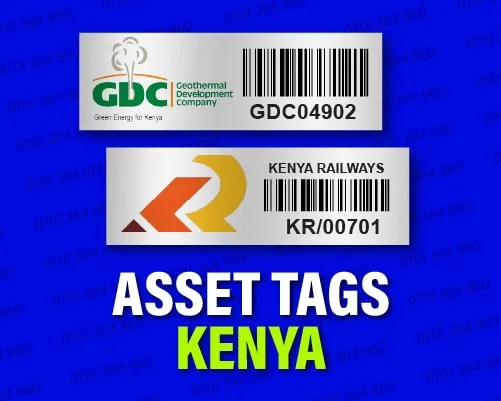
The price of fixed asset tags in Kenya is not one number. It depends on the material, size, quantity, what is printed and how the tags are fixed. This guide explains each cost factor so you can plan a budget, then send us your quantities for an exact quote with a free design proof.
What drives the cost of asset tags
| Factor | Lower cost | Higher cost |
|---|---|---|
| Material | Polyester labels | Anodized aluminium, stainless steel |
| Quantity | Larger orders (set-up cost is shared) | Very small orders |
| Size | 39 x 13 mm standard size | Large sizes up to 100 x 50 mm, custom shapes |
| Printing | One colour, number only | Full-colour logo, colour coding |
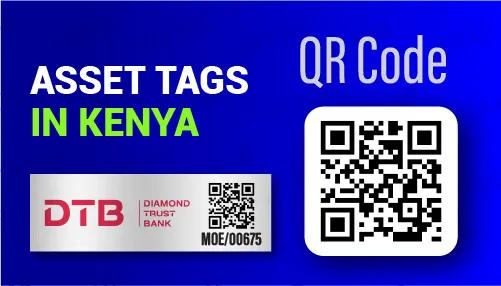
| Code | Plain numbers | Barcode or QR with variable data |
| Fixing | Self-adhesive | Acetone-activated, rivet holes, tamper-proof |
| Service | Tags supplied only | Verification, on-site tagging and a register |
Material type and its impact on price
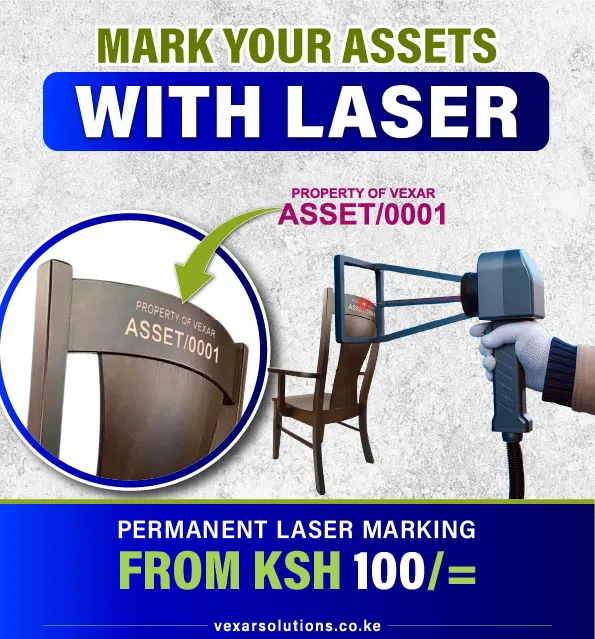
Polyester labels cost least and suit indoor IT equipment. Anodized aluminium costs more but lasts far longer on furniture, equipment and outdoor assets, which usually makes it cheaper over the life of the asset because you avoid re-tagging. Laser marking has no tag cost but is charged by the item. Compare materials in aluminium vs other materials.
Size and shape
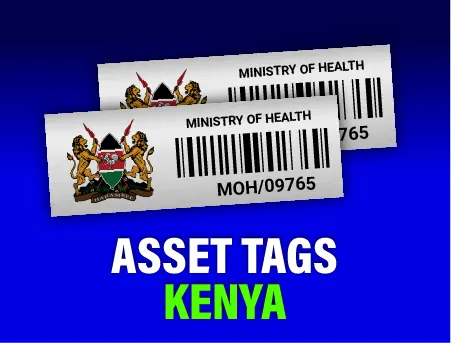
Smaller standard sizes are the most economical. Our standard and recommended size, 39 x 13 mm, is the most economical and fits most assets. We also print 45 x 15, 50 x 20, 50 x 30, 60 x 30, 75 x 40, 80 x 50 and 100 x 50 mm. Large tags or custom shapes use more material and need special tooling. We recommend the smallest size that keeps the number and barcode easy to read.

Printing, data and serialisation
Every tag carries a different number, and often a different barcode or QR code. Sequential numbering is standard; matching a list of existing numbers takes a little more preparation. A multi-colour logo adds cost compared with one colour.

Quantity and bulk orders
Design, proofing and machine set-up are the same whether you order 100 or 5,000 tags, so the price per tag falls as quantity rises. Ordering tags for all asset classes at once, and a stock of spare numbers for new purchases, is usually cheaper than several small orders.

Environment and durability requirements
Tags for outdoor, hot, oily or frequently cleaned assets need anodized aluminium, stronger adhesives or rivets. Indoor office assets can use lower-cost options. Matching tag type to environment avoids paying for durability you don't need, and avoids replacing cheap tags that fail.

Adhesive and mounting options
Self-adhesive backing is the simplest. Acetone-activated adhesive gives a permanent bond on difficult surfaces. Rivet or screw holes suit vehicles and machinery. Tamper-proof labels cost a little more but protect high-theft items.
Tags only vs a full tagging service
Buying tags only is the lowest outlay if your team has time to verify and tag assets. Our fixed asset tagging service adds verification, on-site tagging, data capture and a digital register, often the more economical choice for large or multi-site organisations because it is done once and done right.
Hidden costs of cheap asset tags
The cheapest tag is not always the cheapest option. Paper and low-grade vinyl labels fade, peel or get scratched off, and every lost tag means re-identifying the asset, reprinting and re-applying, often during the next audit, when time is shortest. Tags that fail also leave gaps in the register that auditors query. Spending a little more on the right material for each asset class usually lowers the total cost of keeping a reliable register.
How to budget for an asset tagging project
- Count assets by class: ICT, furniture, vehicles, equipment, tools.
- Match a tag type to each class: polyester for indoor IT, aluminium for furniture and equipment, riveted or laser marking for vehicles and tools.
- Add spares: roughly 5 to 10% extra numbers for new purchases and replacements.
- Decide on service: tags only, or verification and on-site tagging.
- Consider software: Excel is enough for small registers; larger ones benefit from asset management software.
Industry standards worth paying for
- Anodized (not surface-printed) aluminium for long-life assets.
- High-contrast barcodes with proper quiet zones so they scan first time.
- Unique, sequential numbering with no duplicates.
- An adhesive rated for the surface and environment.
- A proof approved before production.
Related guides
How to choose aluminium tags · Cost-effective asset tagging · Top 5 types of fixed asset tags · Fixed asset verification for SMEs
Get an exact quote
Send us the number of assets, the types of assets and your logo. We reply with recommended tag types, a price and a free proof. For budget options, see affordable asset tags with barcodes.
To compare tag types and sizes before you ask for a quote, see asset tags in Kenya.
Asset tag prices at a glance
| Tag type | Price from |
|---|---|
| Aluminium asset tags (39 x 13 mm standard) | KSh 60 per tag |
| Barcode asset tags | KSh 60 per tag |
| QR code asset tags | KSh 60 per tag |
| Self-adhesive asset tags | KSh 60 per tag |
| Polyester asset tag labels | KSh 35 per tag |
| On-site asset tagging service | KSh 50 to KSh 250 per asset |
Prices are starting prices. Bulk discounts are available for larger quantities. The on-site tagging rate depends on the quantity and on how many details are captured per asset during installation. Prices exclude delivery and VAT where applicable; ask for an exact quote.
Frequently asked questions
How much do asset tags cost in Kenya?
The price depends on material, size, quantity, printing and fixing method. Polyester labels cost least, anodized aluminium costs more but lasts longer, and larger orders lower the price per tag. Send us your quantity and asset types for an exact quote.
Is there a minimum order?
We can print small quantities, but set-up costs mean the price per tag is lower on larger orders. Ordering all asset classes together with some spare numbers is usually most economical.
Does the price include tagging the assets?
Tag prices cover the printed tags. Verification, on-site tagging, data capture and the asset register are quoted separately as part of our fixed asset tagging service.
Are aluminium tags worth the extra cost?
For furniture, equipment, vehicles and outdoor assets, yes. They last for the life of the asset, so you avoid re-tagging at every audit. For indoor IT equipment, polyester labels are often good value.
Do you charge for design?
Every order includes a free digital proof showing your logo, numbering and barcode or QR code before production.
Order online

Helpful guides

Guide, 2 min read
Fixed Metallic Asset Tags: A Practical Guide
Understand fixed metallic asset tags, surface compatibility, barcode layout and attachment choices for equipment identif…

Guide, 5 min read
5 Types of Fixed Asset Tags for Efficient Asset Tagging
The 5 fixed asset tag types most used in Kenya, compared: aluminium, barcode, QR, polyester and tamper-proof, with the a…
Guide, 2 min read
Fixed Asset Tagging Checklist
Use this fixed asset tagging checklist to prepare staff, asset data, tag specifications, site access, verification and p…