





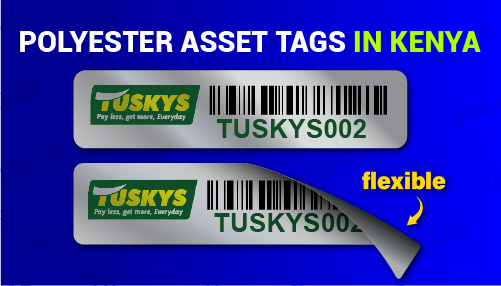


Public institutions in Kenya are under increasing pressure to maintain accurate records of the assets they own, control and use. For county governments, universities, hospitals and other public entities, the transition to IPSAS accrual accounting makes reliable physical asset identification even more important.
This is where asset tags Kenya public institutions use can provide a practical control.
A properly numbered barcode or QR-coded asset tag creates a direct connection between a physical asset and its accounting record. It can help finance and procurement teams identify assets, verify their existence, investigate discrepancies and maintain more accurate asset registers.
For institutions dealing with thousands of assets across offices, hospitals, campuses, workshops and regional facilities, physical tagging can be an important part of cleaning up asset records and addressing audit queries.
What Are Ghost Assets in Public Sector Asset Management?
A ghost asset is an asset that appears in an organisation’s records but cannot be physically located or verified.
For example, a county government may have a fixed asset register showing a vehicle, medical equipment, generator or computer system that cannot be found during physical verification.
The asset may have been:
- Transferred to another department
- Moved to another county facility
- Disposed of without proper record updates
- Lost or stolen
- Written off incorrectly
- Replaced but not removed from the register
- Recorded more than once
- Purchased but never properly received
- Misidentified in the asset register
Ghost assets create a serious information gap.
The accounting records suggest that an asset exists, while the physical evidence suggests otherwise.
This can make financial reporting, audit work and management decision-making more difficult.
Why Asset Tags Kenya Public Institutions Need Can Help
An asset tag gives each physical item a unique identity.
Instead of relying solely on a description such as “HP laptop” or “Toyota vehicle,” an institution can assign an identification number such as:
Asset ID: UON-ICT-2026-00452
That number can appear on the physical asset and in the asset register.
A barcode or QR code can make the identification process even more efficient.
During a physical verification exercise, an officer can scan the tag and compare the asset’s information against the institution’s digital or accounting records.
This creates a simple relationship:
Physical Asset → Asset Tag → Asset Register → Accounting Records
When the information agrees, the asset can be verified.
When it does not, the discrepancy can be investigated.
IPSAS Accrual Accounting and Asset Records in Kenya
The transition towards accrual-based public sector accounting places greater emphasis on recognising and reporting assets and liabilities in a way that reflects the economic resources controlled by an entity.
For public institutions, this means asset information cannot simply exist as disconnected spreadsheets or historical procurement records.
There needs to be a reliable process for identifying what the institution owns or controls and maintaining appropriate records around those assets.
This makes physical asset verification particularly important.
For example, a public hospital may have medical equipment distributed across:
- Main hospital wards
- Laboratories
- Operating theatres
- Pharmacies
- Diagnostic departments
- Satellite facilities
- Stores
Without consistent identification, determining the exact location and status of each asset can become difficult.
A structured tagging programme gives every item a physical reference point.
How Asset Tags Help Clean Up Ghost Assets
Cleaning up a fixed asset register should begin with physical verification.
The organisation can extract the current asset register and compare it against what actually exists.
Each asset can then be classified according to its verification status.
| Verification Status | Meaning | Recommended Action |
|---|---|---|
| Verified | Asset physically located and identified | Retain and confirm records |
| Missing | Recorded but cannot be located | Investigate |
| Transferred | Asset moved to another location | Update records |
| Disposed | Asset no longer in use | Review disposal documentation |
| Duplicate | Same asset appears more than once | Correct register |
| Unrecorded | Physical asset exists but is absent from register | Investigate and record |
| Damaged | Asset exists but is not operational | Update condition/status |
| Unidentified | Asset exists but ownership or record is unclear | Investigate |
This process can expose ghost assets while also identifying assets that have never been properly recorded.
The result is a more reliable asset register.
From Phantom Entries to Verified Public Assets
A common mistake is to focus only on assets that appear in the register.
Physical verification should work in both directions.
The organisation should ask:
Does every recorded asset physically exist?
But it should also ask:
Is every significant physical asset properly recorded?
The second question is particularly important for public institutions.
A hospital may discover medical equipment that was transferred from another facility but never properly reflected in the receiving department’s records.
A university may discover furniture or computers that have been moved between campuses.
A county workshop may have machinery that is physically present but poorly documented.
These are not necessarily ghost assets.
They are examples of gaps between physical asset custody and accounting records.
The Role of Barcode Tags Nairobi Institutions Can Use
Large institutions can have thousands of individual assets.
Manually recording every asset number during physical verification creates opportunities for transcription errors and slows the process.
Barcode tags can simplify identification.
An officer can scan the barcode using a compatible scanner or mobile device and retrieve the corresponding asset record.
The workflow becomes:
Locate → Scan → Identify → Verify → Update
For institutions searching for barcode tags Nairobi suppliers can provide, the important consideration is not simply the printed barcode.
The tag must remain readable for the expected asset lifecycle.
For indoor computers and office furniture, durable synthetic labels may be adequate.
For outdoor equipment, workshops, vehicles and machinery, more durable materials may be required.
QR Codes for Public Asset Verification
QR codes offer another option for public sector institutions.
Unlike traditional one-dimensional barcodes, QR codes can contain more information and can be scanned using many smartphones and mobile devices.
A QR-coded asset tag can potentially connect an officer directly to an asset record.
For example, scanning a tag on a hospital generator could open a digital record containing:
- Asset number
- Description
- Location
- Department
- Custodian
- Acquisition information
- Maintenance history
- Verification status
The specific functionality depends on the software platform being used.
The QR code itself is simply the identification mechanism.
The institution still needs accurate records and proper asset-management procedures.
National Treasury Guidelines Kenya Institutions Should Consider
Public sector asset management should be aligned with applicable requirements and guidance issued by the relevant Kenyan authorities.
National Treasury plays an important role in public financial management and the development of accounting and reporting frameworks for government entities.
Institutions should therefore avoid treating asset tagging as an isolated procurement exercise.
The tagging programme should form part of a broader asset-management process covering:
- Acquisition
- Recognition
- Identification
- Custody
- Location
- Maintenance
- Verification
- Transfer
- Impairment
- Disposal
- Record keeping
This creates a complete asset lifecycle.
The physical tag is one part of that system.
Asset Tags and Auditor-General Queries
Auditor-General queries can arise when public institutions cannot adequately reconcile their reported assets with physical verification results or supporting documentation.
For example, an audit review may identify:
- Assets recorded but not physically verified
- Assets without identification numbers
- Assets with incomplete records
- Unexplained differences between registers
- Assets whose locations are unknown
- Unrecorded assets
- Inadequate supporting documentation
- Delayed disposal of obsolete equipment
Asset tagging does not automatically resolve an audit finding.
However, it can provide a practical mechanism for improving physical identification and verification.
A consistent asset numbering system allows an institution to demonstrate that physical assets have been systematically identified and reconciled with its records.
How to Conduct a Public Sector Asset Verification Exercise
A structured verification exercise is more effective than simply walking through offices and ticking assets off a spreadsheet.
Step 1: Obtain the Latest Asset Register
Start with the most recent available records.
Step 2: Organise Assets by Location
Group assets according to county, facility, department, campus, ward or other relevant location.
Step 3: Conduct Physical Verification
Locate each asset and confirm its identity.
Step 4: Check Existing Identification
Record the existing asset number and serial number.
Step 5: Tag Unidentified Assets
Apply a new unique asset tag where appropriate.
Step 6: Investigate Exceptions
Create separate records for missing, transferred, damaged, duplicated or unrecorded assets.
Step 7: Reconcile the Register
Update the relevant records after completing the investigation.
Step 8: Establish Ongoing Controls
Make asset tagging part of the normal acquisition and asset-transfer process.
This prevents the organisation from returning to the same problem a year later.
Choosing the Right Material for Public Sector Asset Tags
Not every government asset requires the same type of physical label.
An office computer inside an administrative building experiences different conditions from a county vehicle or water-treatment pump.
| Asset Environment | Suitable Tag Type | Typical Application |
|---|---|---|
| Office | Durable vinyl/polycarbonate | Computers, desks, printers |
| Hospital | Polycarbonate or durable synthetic | Medical and IT equipment |
| University | Barcode/QR synthetic or aluminium | ICT, laboratory equipment |
| Workshop | Anodized aluminium | Machinery and tools |
| Outdoor facility | Anodized aluminium | Pumps, generators, equipment |
| County vehicles | Durable aluminium | Fleet identification |
| Agricultural equipment | Aluminium | Tractors and machinery |
| Construction equipment | Heavy-duty aluminium | Plant and machinery |
Material selection should consider the expected asset lifecycle and environment.
Why Anodized Aluminium Works for Outdoor Public Assets
Public assets can operate in challenging environments.
A county government may have equipment deployed in dusty areas.
Agricultural institutions may operate machinery around soil, fertilizer and moisture.
Road and construction departments can expose equipment to mud, vibration and physical abrasion.
Anodized aluminium can provide a durable surface for asset identification in these environments.
It can offer better resistance to UV exposure, scratching and general environmental wear than many basic labels.
However, the complete tag specification matters.
The marking method, adhesive and installation process must also be appropriate for the application.
Asset Tagging and Public Procurement Controls
Asset tagging should ideally begin when an asset is received rather than years after it has entered service.
A strong process can look like this:
Procurement → Receiving → Inspection → Asset Registration → Tagging → Assignment → Verification
This creates an audit trail from acquisition to physical custody.
For public institutions operating under Kenya’s public procurement and asset disposal framework, maintaining clear records around assets, custody and disposal is particularly important.
Tagging can therefore be integrated into the receiving process.
Once an item has been inspected and accepted, the responsible team can assign its unique asset number and apply the corresponding tag.
Preventing Unrecorded Assets
Ghost assets are only one side of the problem.
Public institutions can also have physical assets that are not properly recorded.
For example, equipment may be:
- Donated
- Transferred
- Reallocated
- Acquired through a project
- Received from another public entity
- Purchased through a programme
- Reassigned between facilities
If the asset does not enter the asset-management process, it may remain physically present but absent from the main register.
A tagging and verification programme can help identify these assets.
The institution can then investigate their origin, ownership, value and appropriate accounting treatment.
How Asset Tags Support IPSAS Accrual Accounting
IPSAS accrual accounting requires public sector entities to recognise and report assets and liabilities based on applicable accounting principles rather than relying solely on cash transactions.
That increases the importance of reliable asset information.
An institution cannot manage its property, plant and equipment effectively if it does not know what assets exist, where they are located or what condition they are in.
Physical identification therefore supports the broader accounting process.
The asset tag itself is not an accounting entry.
It is a physical control that helps connect the accounting record to the underlying asset.
This distinction is important.
The tag supports the system; it does not replace accounting judgement or IPSAS requirements.
Common Asset Tagging Problems in Public Institutions
Several problems can undermine an otherwise effective tagging programme.
Duplicate Asset Numbers
Every asset should have a unique identification number.
Inconsistent Numbering
Different departments should not create unrelated numbering systems.
Poor Tag Placement
Tags should be positioned where they can be accessed during verification but are protected from unnecessary damage.
Weak Materials
Indoor labels may fail when applied to outdoor or industrial assets.
Missing Transfer Records
Moving an asset without updating its location creates inaccurate records.
No Verification Schedule
Tags are most useful when supported by regular physical verification.
Treating Tagging as a One-Time Project
Asset management is an ongoing process.
How Procurement Officers Can Build a Better Tagging System
Procurement teams should define technical requirements before requesting quotations.
Consider specifying:
- Tag material
- Tag dimensions
- Thickness
- Numbering sequence
- Barcode or QR format
- Adhesive specification
- Outdoor durability
- UV resistance
- Chemical resistance
- Tamper-evident options
- Artwork and logo requirements
- Sample approval
- Delivery requirements
For large public institutions, suppliers should also be able to maintain numbering continuity across repeat orders.
For example, if the first procurement ends at asset number 005000, the next batch should continue from 005001 rather than starting again.
This helps prevent duplicate identifiers.
Asset Tags Kenya: A Practical Solution for Cleaner Public Asset Records
Public sector institutions cannot rely on accounting records alone to understand the physical assets they control.
The transition to IPSAS accrual accounting makes accurate asset information increasingly important, while audit and physical verification exercises can expose gaps between recorded and actual assets.
Asset tags Kenya institutions use can provide the physical identification layer needed to connect individual assets with their records.
Barcode and QR tags can make verification faster, while durable aluminium tags are appropriate for equipment exposed to outdoor and industrial conditions.
The most effective approach is to combine physical tagging with accurate registers, defined custodianship, documented transfers, regular verification and proper accounting procedures.
Build a More Reliable Public Asset Register
If your county government, university, hospital or public institution is dealing with missing assets, unidentified equipment or recurring verification challenges, a structured tagging programme can help establish better physical control.
Start by reviewing your current asset register and identifying where physical identification is weak.
Then select the appropriate tag material and technology for each asset category.
Request a quote or order a free sample pack of asset tags in Kenya to test barcode or QR readability, material durability, adhesive performance and tag placement before beginning a wider rollout.
A clean asset register starts with knowing exactly what exists, where it is located and which record belongs to it.